How Hands-on STEM Education Encourages a Culture of Collaboration
April 30, 2026 At TAF, we know the best kind of learning happens when students are centered, and every person in the education ecosystem moves with that
April 30, 2026
At TAF, we know the best kind of learning happens when students are centered, and every person in the education ecosystem moves with that understanding. This is one of the main drivers at the heart of TAF@Saghalie’s STEM Expo – a Science Fair and gallery walk where students from neighboring schools, volunteers, and community partners to see the breadth of student imagination and innovation come to life at TAF@Saghalie.
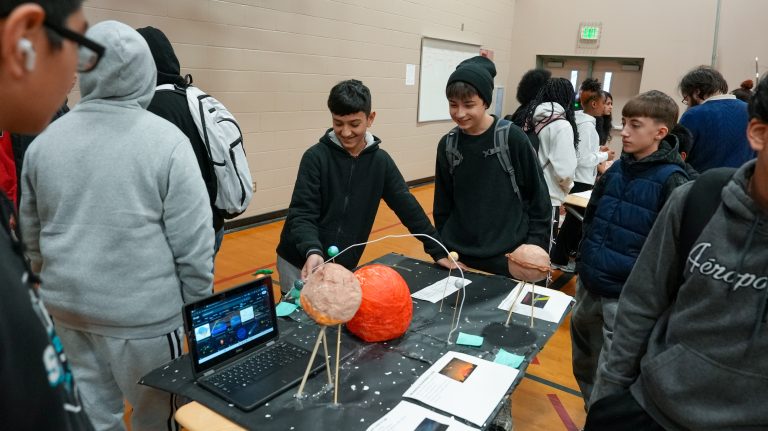
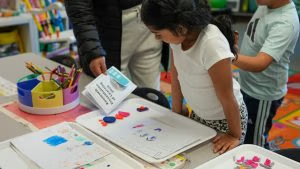
This year, middle schoolers presented their final projects and processes, covering a wide range of science topics. 6th graders explored solutions around public health and how to prevent outbreaks of illness, 7th graders gathered in the gymnasium to show off their mathematically scaled models of various planets, moons, and asteroids, and 8th graders partnered with Northwest Food Alliance to address the issue of green washing products and minimizing waste in their communities.
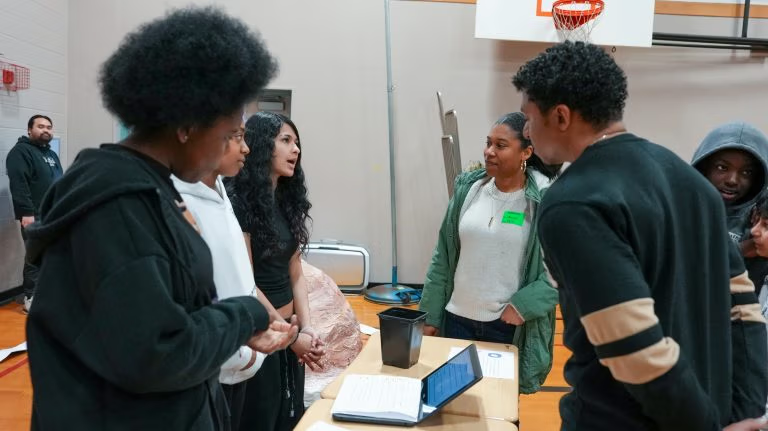
The hallways are bustling with staff, shuffling students from classroom to classroom to watch their peers present, while volunteers wait with excitement to welcome students in. This kind of collaboration is necessary – from everyone involved in the process, in the classroom, and the project cycle.
For students, it’s an opportunity to see what they’re capable of when working as a team, building project timelines, and navigating challenges. They’re able to pull all the lessons they’ve learned in different subjects into one solution. There is also an intentional shift in focus to evaluating what students have learned throughout the entire learning process – even if the final project isn’t polished or complete, rather than the finished project as the sole indicator of success. Students also get the chance to practice their communication skills by sharing what lessons they learned as they present to multiple different audiences.
For those helping to cultivate the learning environment, it’s a way to model how collaborating as a team can look. For teachers, this can look like taking an active step in becoming more of a partner rather than an authority figure in the classroom. For community partners, this looks like working alongside kids in the ideation and prototyping process or giving feedback on how to refine their ideas.
It’s a lot of moving parts making something like this come together for a whole middle school, but the intention behind the design is practical. “Working with a team and putting it together with a real-life solution… every child is exposed to what they [will] be facing in the real world.” Cindy Golson, retired professional from the tech industry and TAF volunteer shared, reflecting on what really inspired her about participating in STEM Expo. This is at the heart of our project cycles – to really take the theory learned in the classroom and put it into practice.
For one group of seventh grade girls, Valentina, Aria, and Nuvia, the internalization of this process could be seen throughout their approach of building a large model of Saturn. So large, they had to disassemble the gymnasium door to fit it through! In the process of completing their tasks – which included mathematics, humanities, and engineering — they learned a lot about what it takes to struggle through a problem as a team to find a solution on the other side.
“It was very difficult to build because sometimes we’d get on each other’s nerves…but it worked out.” One of the girls reflected. But all in all, the team ended more unified, trusting they could lean on one another. “[A big takeaway] was working together and creating a bigger bond in our friendship, as well as…having fun [and] building something new.”
This level of collaboration isn’t something that happens in a vacuum or siloed away in one school and one classroom, and these students don’t learn how to collaborate by being lectured to. This is modeled in practice, and in action by teachers and community partners who care. This level of engagement from students with other students is available to every school and district, so long as everyone is on the same page: approach teaching as a team sport and be guided by prioritizing the student experience.
This is a process that starts at the beginning of the year through the dedication of a TAF Transformational Coach in partnership with TAF staff, and teachers willing to try something new. See how TAF@Saghalie started off the year with a project that encouraged students to think what skills and special talents they bring to the table, the importance of belonging, and the strength of working together as a community.

April 30, 2026 At TAF, we know the best kind of learning happens when students are centered, and every person in the education ecosystem moves with that

Students team up against their teachers in a tug-of-war competition during the second assembly of the year, put on by Student Ambassadors. “I see school

Vy Nofua, operations manager at Northwest Furniture gives feedback and review on a First Creek student’s cardboard prototype. At TAF, we see social-emotional learning (SEL)